
How to Use AI to Manage Customer Reviews and Build Loyalty in Restaurants
Real-time monitoring, personalised replies, turning negative reviews into opportunities: the 2026 AI playbook for independent restaurants.
A 1-star Google review left unanswered remains visible for years. A 5-star review without a reply goes unnoticed. For an independent restaurant, review management is not a marketing detail, it is a direct booking driver. And it is one of the most time-consuming tasks of the week.
AI now lets you automate 80 % of that workload without losing the venue's voice. Here is how, step by step.
Why reviews carry such weight in hospitality
According to a 2024 TheFork study, 67 % of guests check at least three review platforms before booking a restaurant they do not know. An average rating moving from 4.1 to 4.5 on Google increases booking rate by 22 % on average over six months.
The reverse is also true. Three unanswered negative reviews at the top of the page can halve new bookings within three months. Speed of response and tone have become as critical as the quality of the dining experience itself.
The 3 pillars of automated review management
Tailored advice
Leading an AI transformation in your SMB or mid-sized company? Identify your top 3 priorities in 30 minutes.
Book my free diagnostic →1. Real-time monitoring
The first reflex is to be alerted as soon as a review lands on Google, TripAdvisor, TheFork and ideally on social media. Without monitoring, you discover reviews late, sometimes too late to reply usefully.
Recommended tools: Google Alerts (free) for web mentions, the Google Business API for Google reviews, and a Zapier module to centralise notifications in a dedicated Slack or Telegram channel.
2. Drafting the replies
This is where AI changes the game. ChatGPT (or Claude) receives the review text, your reply playbook and the desired tone. It generates a personalised 3 to 5-line reply: acknowledgement of the feedback, specific element mentioned by the guest, concrete action proposed.
Simplified prompt example:
"You are the owner of a family bistro in Bordeaux. Reply to this review in 4 lines maximum. Mention the dish or moment the guest cited. End with a warm invitation to come back. Warm but understated tone, never salesy."
3. Validation and publishing
For ratings of 4 stars and above, the reply is sent automatically after a quick approval (one click). For ratings under 3 stars, the reply always goes through your hands before publishing. That is the rule.
The 5-step workflow
For a 30 to 60-seat restaurant, deployment takes 2 to 3 days:
- Connect Google Business and TheFork to Zapier through their official APIs.
- Define the reply playbook with the front-of-house team (vocabulary, signature, signature dishes to highlight).
- Build the ChatGPT prompt and test it on 10 historical reviews to fine-tune tone.
- Set up the validation channel (a dedicated Slack or Telegram channel).
- Launch in supervised mode for two weeks before allowing automatic publishing on positive reviews.
Total monthly budget: 45 to 60 euros for the full stack. Time saved: 4 to 7 hours per week depending on review volume.
Turning negative reviews into opportunities
A well-handled negative review does more for your reputation than a positive one. It is counter-intuitive but documented: Harvard Business Review reported in 2023 that businesses replying to over 80 % of their negative reviews see their average rating climb by 0.3 points over six months.
The right reflex:
- Acknowledge precisely what disappointed, without generic apologies.
- Provide a factual explanation if there is one (out-of-stock item, menu change, busy night).
- Propose a concrete action: a comeback to verify the issue was fixed, a direct phone call, occasionally a measured commercial gesture.
AI drafts, you approve the gesture. That split saves significant time without dehumanising the relationship.
The pitfalls to avoid
Automating replies to highly negative reviews without review. The risk of escalating is real, the cost of a quick check is zero.
Using the same prompt for every cuisine. A pizzeria does not reply like a fine-dining restaurant. The tone must reflect your identity.
Forgetting positive reviews. A 5-star guest left unanswered is a guest who feels generic. A short but genuine reply reinforces loyalty.
What AI really changes in the dining room
AI does not replace listening on the floor, remembering a regular's name, suggesting a dessert. It frees up the time currently swallowed by digital tasks so it can be reinvested into what builds loyalty: the direct relationship with the guest.
In the IMPACT methodology, this automation maps to the Implementation phase. AI is not deployed for AI's sake. It is deployed where it frees up useful time for human value.
If you want to identify the most profitable automations for your venue in one session, the TransformAudit produces an operational roadmap in 2 days.
Let's take action
Ready to structure your AI transformation?
Free 30-minute diagnostic to identify your top priorities and estimate concrete ROI for your organization.
Book my free diagnostic →Related articles
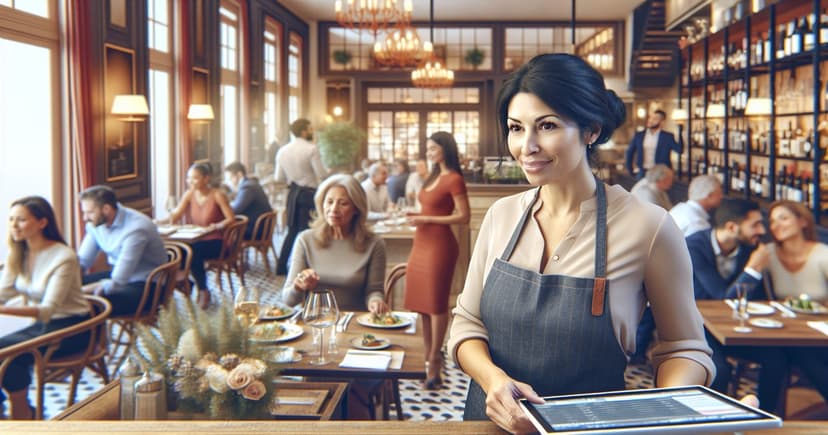
AI for restaurants: automate reservations, menus and reviews for a 30-seat venue
How an independent 30-seat restaurant uses ChatGPT, Zapier, TheFork and the Google Reviews API to save 2 hours a day and improve its Google rating by 0.4 points in 6 weeks.

AI and Medical Practices: Automate Appointment Reminders and Patient Follow-Up
Cut no-shows, smooth out post-consultation follow-up and simplify patient journeys with AI, while staying compliant with healthcare data regulations.

How to Build an AI Agent That Manages Your HR Applications from A to Z
Learn how to automate CV screening, candidate qualification and follow-up with an n8n AI agent — no coding skills required.