How a Restaurant Owner Can Increase Reservations by 28% With a WhatsApp Chatbot
Sophie, a restaurant owner in Marseille, grew her bookings by 28% in two months with a WhatsApp chatbot. Here is her 6-step method.
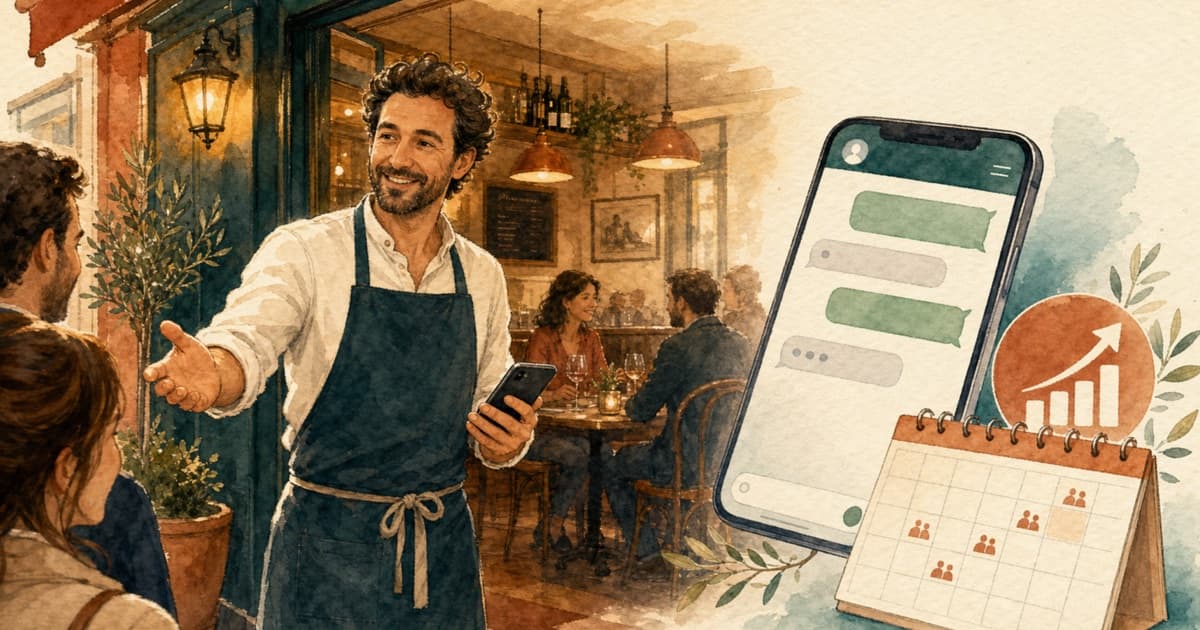
Sophie stopped picking up the phone during rush hour, and it was costing her
Sophie runs a 40-seat restaurant in Marseille. Like most restaurant owners, she received the bulk of her reservation requests by phone, often at the worst possible time: between noon and 2pm, or in the middle of dinner service, when the whole team is on the floor or in the kitchen. According to her own point-of-sale statistics, 60% of reservation requests came in by phone during peak hours, with a pickup rate of only 70%. In practical terms, three calls out of ten went unanswered, and some of those customers never called back.
This is a pattern I see across most independent business owners and small shop owners I work with: the phone, meant to be a growth tool, quietly becomes a source of lost revenue. The abandoned customer does not file a complaint, they simply go eat somewhere else.
AI adoption is accelerating among French small businesses
Sophie's situation is not unique. A 2025 Bpifrance Le Lab study found that 55% of French micro and small businesses were using generative AI by the end of 2025, up from just 31% a year earlier. This shift, described by Bpifrance as a "quiet revolution," now reaches every sector, including hands-on trades like restaurants, where these tools were long assumed to be reserved for large chains.
On the customer service side, the trend is even sharper. According to Gartner, 85% of customer service leaders planned to explore or pilot a customer-facing conversational AI solution in 2025, and the firm expects that by 2028, 70% of customers will start their service journey through a conversational interface rather than a traditional phone call. McKinsey similarly found that 46% of small businesses already use AI-powered customer engagement tools, chatbots leading the way, ranking just behind search engines in their daily digital usage.
In other words, Sophie did not take a wild gamble. She followed an underlying trend, and got ahead of a good number of her fellow restaurant owners in the process.
The solution: a WhatsApp chatbot connected to her reservation system
Rather than adding another phone line or hiring a receptionist, Sophie deployed a WhatsApp Business chatbot connected to Zenchef, her reservation software, through an automation workflow built with n8n. The idea: capture reservation requests at any hour, including outside service times, and feed them automatically into her booking calendar.
Here are the 6 steps she followed with her provider:
- Set up a WhatsApp Business account with a dedicated number and a complete business profile (hours, menu, booking link).
- Connect Zenchef and n8n to sync real-time availability shown to customers with the actual floor schedule.
- Write automated response scripts covering the most common requests: availability, party size, simple allergy questions, opening hours.
- Automate cancellation handling, immediately freeing up the slot in Zenchef and offering it to customers on the waitlist.
- Automatically follow up on empty slots the day before and the day of, with a targeted WhatsApp message for historically under-booked time slots.
- Review results weekly: conversation-to-booking conversion rate, recovered slots, average response time.
None of these steps required Sophie to write a single line of code herself. Her role mainly involved approving the response scripts and checking, week to week, that the chatbot's tone matched her restaurant's image.
The results, two months in
In two months, Sophie increased her reservations by 28%. The chatbot mainly recovered requests that used to fall outside the restaurant's opening hours or during peak call volumes that went unanswered. For an investment of about 80 euros a month, she estimates the gain at 1,800 euros in additional monthly revenue, largely tied to covers that used to go to competitors simply because no one answered.
That ratio, roughly 22 euros in return for every euro invested, shows why this kind of project deserves a closer look even in a small business where every expense matters.
What this means for any independent business owner
The principle Sophie used has nothing specific to restaurants. A physiotherapist can apply it to appointment management, an auto repair shop to quote requests, a hairdresser to last-minute slots. The common thread: a customer request that can arrive at any hour, an existing business tool (calendar, point-of-sale, schedule) that is not yet connected to an automated communication channel, and a conversion gap that quietly bleeds revenue every week without anyone noticing.
This is exactly the kind of hidden opportunity I look for during scoping: an AI diagnostic of your business that results in a 90-day roadmap, prioritized by actual return on investment rather than by technological novelty. The approach I use always starts with a precise diagnostic and scoping phase before launching any implementation work, specifically to avoid investing in a tool that does not solve a real, everyday problem.
Where to start if you want to test this kind of automation
Before you jump in, ask yourself three simple questions: how many customer requests do you receive outside your opening hours, how many calls or messages go unanswered each week, and what is the average ticket of a typical customer you lose because of slow response times. Those three numbers are already enough to estimate, as with Sophie, the potential return on investment of a chatbot connected to your business tool.
If you want to assess this potential for your own business, with no technical jargon and a concrete action plan, get in touch. Together, we will find where the revenue your phone is letting slip away is hiding.
Frequently asked questions
Does a WhatsApp chatbot fully replace phone reservations?
No, and that is not the goal. The chatbot absorbs simple, repetitive requests (availability, opening hours, confirmations) and requests that come in outside opening hours. Special cases, such as large groups, allergies, or private events, are automatically routed to a staff member. Human contact remains the norm for anything outside the standard flow.
How much does it actually cost to set up a WhatsApp Business chatbot for a restaurant?
For a venue like Sophie's, the monthly budget runs around 80 euros: the WhatsApp Business API subscription, the connector to the existing reservation software, and hosting for the automation workflow. Plan for about a week of initial setup, usually with the help of a provider for configuration.
Do you need technical skills to manage the tool day to day?
No. Once the workflow is configured, day-to-day management is limited to monitoring the reservation dashboard and adjusting the response scripts when the menu or hours change. The initial setup, on the other hand, does require technical expertise, which is why getting support for that first deployment is worthwhile.
Does this approach work for businesses other than restaurants?
Yes. The principle, capturing a customer request around the clock via WhatsApp, automatically qualifying it, then routing it to the right business tool, also applies to hair salons, auto repair shops, medical practices, or physiotherapy clinics. Only the connected software downstream changes: Zenchef for restaurants, an online scheduling tool for other trades.
What happens if the chatbot does not understand a customer request?
A well-configured setup always includes a fallback: if a customer types something the workflow does not recognize, the message is automatically forwarded to a staff member with an alert. No request should go unanswered for more than a few minutes, even outside the cases covered by the scripts.