Three AI models concentrate 91% of usage: the risk most SMBs don't see
A handful of models now dominates most AI usage worldwide. For an SMB that has built its processes around a single tool, that is not a technical footnote.
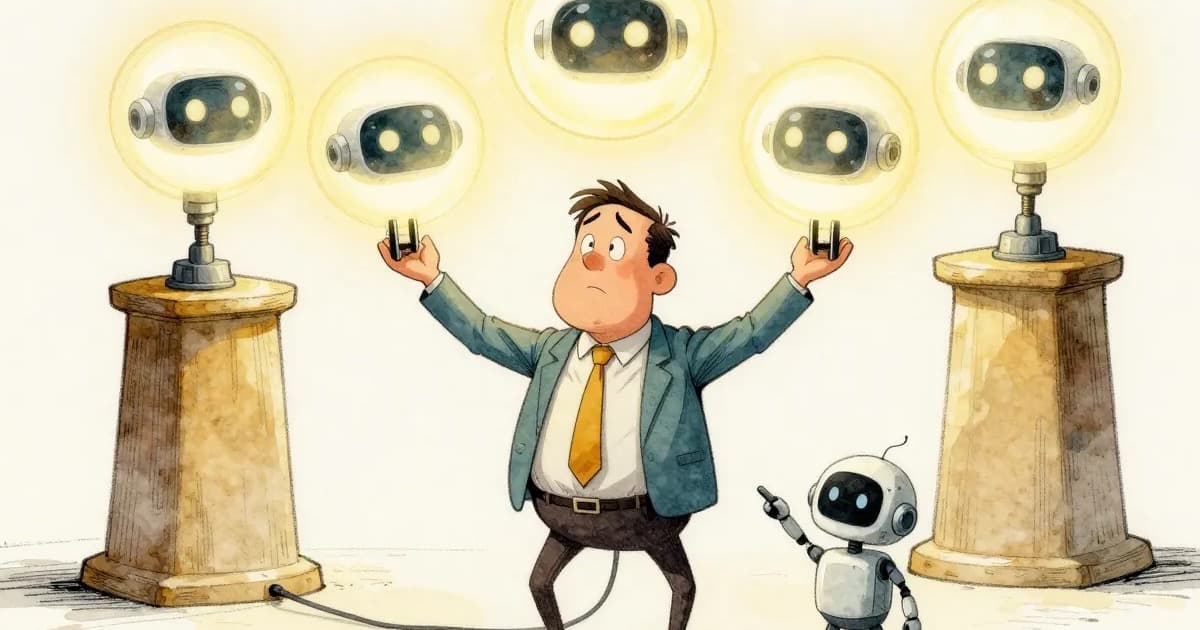
Three model families are said to concentrate more than 90% of generative AI usage worldwide today, according to an analysis reported by Journal du Net in 2026. The term used is a strong one, cognitive monoculture, the fear that most of the text written, the analyses produced, and the decisions prepared with AI share the same biases, the same limits, and the same blind spots, without anyone really noticing.
For a large corporation, this debate stays largely theoretical. For an SMB, it has a concrete and rarely anticipated consequence. Most of the business owners I work with built their first AI use case around a single tool, chosen for convenience or on a colleague's recommendation. Within a few months that choice becomes the invisible infrastructure of one or more business processes, drafting customer replies, a first pass on candidate screening, summarizing sales documents. The initial choice is not the problem, it is often legitimate and relevant. The problem is the absence of a plan if that vendor changes its pricing, its terms of use, or suffers a prolonged outage.
The models dominating the market today are no longer the ones from two years ago. GPT-5.5 and its fast variant GPT-5.5 Instant have replaced GPT-4 and GPT-4o. Claude Opus 4.7 and Claude Sonnet 4.6 have taken over from Claude 3. Gemini 3.1 Pro has succeeded Gemini 2.5. This pace of model turnover is itself an argument against building a critical process on a single fixed tool, what works today can be replaced, improved, or pulled from the market within eighteen months.
This is not a call to multiply subscriptions. For an SMB of ten to fifty people, running three AI tools in parallel costs more in training and governance than it delivers in resilience. The right question is not how many tools to use, it is which of your processes would genuinely stop if your main tool became unavailable for two days. For a convenience use, like rewording an email, the answer barely matters. For automated invoicing or first customer contact, it says a lot about your real exposure.
Article 4 of the AI Act has required, since February 2025, AI competency obligations for any organization deploying or using AI systems. This obligation is not limited to knowing how to use the tool, it includes the ability to document why it was chosen, what risks it carries, and what happens in case of disruption. An SMB that cannot answer these three questions about its main AI tool is not technically at fault, but it is operating without visibility into a risk that will, sooner or later, become operational.
This same finding echoes a broader observation made by several consulting firms in 2026: the companies that handle AI tool version changes best are the ones that separated, from the start, the business process from the tool executing it. The process stays stable, documented, and understood by the team. The tool can change without upending everything else. It is a simple discipline, but rarely put in place before a first incident makes it necessary.
In practice, protecting against this dependency does not require a large budget. Three habits are enough for most SMBs. The first is documenting, for each critical AI use, the manual fallback procedure, the one that worked before the tool existed and that should stay executable in case of an outage. The second is avoiding hard-coding a call to one specific model inside a script or business automation, so it can be swapped without rebuilding everything. The third is revisiting this map every six months, the AI market moves too fast for a January snapshot to still be relevant by year end.
This vigilance is not only technical. It also touches how teams reason. A company where every employee uses the same model to write, summarize, and argue ends up producing documents that resemble each other, with the same phrasing and the same analytical angles. That is not a disaster in itself, but it is worth watching for functions where a diversity of viewpoint has real value, strategic analysis, sales negotiation, hiring. A second human opinion, or occasionally a second model, remains the best corrective against a monoculture of tools.
This is exactly what the usage inventory covers, in week one: mapping not only the company's actual AI usage, but its criticality and its degree of dependency on a single vendor. Market concentration around three models is not a problem French SMBs can solve on their own, it belongs to a global dynamic. But knowing precisely where your own dependency lies remains entirely within your control. A five-business-day diagnostic maps this dependency before it becomes a problem.
Frequently asked questions
What is the 'cognitive monoculture' analysts discuss in 2026?
The idea that three model families concentrate most generative AI usage worldwide, to the point that most companies reason, write, and decide with the same biases and blind spots, without realizing it (Journal du Net, 2026).
Why does this figure matter to an SMB that only uses one AI tool?
Because an SMB that has built its customer service, writing, or data analysis around a single vendor depends entirely on that vendor's product choices, pricing, and uptime. A pricing change or a prolonged outage then hits an entire business process, not just a convenience tool.
Should an SMB use several AI models in parallel?
Not systematically, running multiple tools carries a real training and governance cost. But for critical uses (billing, customer relations, HR decisions), documenting a fallback option prevents a complete activity shutdown if the main vendor becomes unavailable.
Which models are currently the most used in business?
The most common models in early 2026 are GPT-5.5 and its fast variant GPT-5.5 Instant on the OpenAI side, Claude Opus 4.7 and Claude Sonnet 4.6 on the Anthropic side, and Gemini 3.1 Pro on the Google side. GPT-4, GPT-4o, Gemini 2.5, and Claude 3 are outdated and should no longer be used as a reference.
Is AI market concentration a compliance issue?
Indirectly, yes. Article 4 of the AI Act has required, since February 2025, AI competency obligations for any organization deploying or using AI systems. Documenting why a tool was chosen, and what would happen in case of service disruption, is part of that obligation.
How does an SMB assess its actual dependency on a single AI tool?
By listing which business processes would fully stop if the tool became unavailable for 48 hours. If that list exceeds two or three critical processes, the dependency deserves a continuity plan, even a basic one.
Does switching AI models have a hidden cost for an SMB?
Yes, mainly in prompt rewriting, team retraining, and verifying that technical integrations (APIs, connectors) work with the new tool. It is a real cost, but far lower than that of an unplanned service outage.
At which step of an AI project should this topic be addressed?
The Inventory step, in week one, should include the list of AI tools in use and their criticality. That diagnostic is what tells you whether single-vendor dependency is an acceptable risk or an urgent issue.